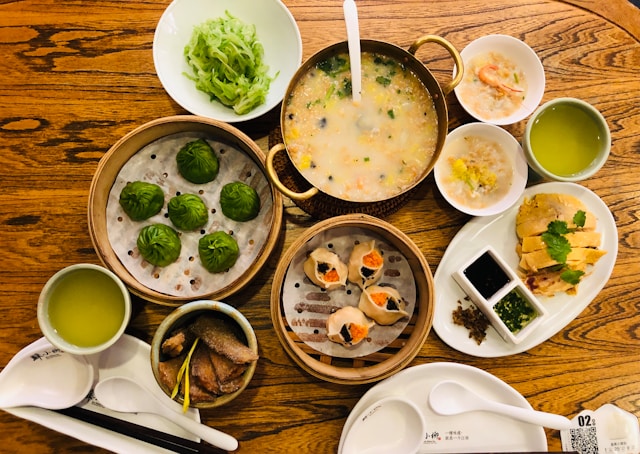
The legendary Chinese soup dumplings xiao long bao have long been a symbol of Shanghai cuisine and a favorite dish of gourmets around the world. These miniature masterpieces, combining delicate dough, juicy meat filling, and aromatic broth inside, amaze not only with their taste but also with the culinary art behind their creation. However, the history of xiao long bao goes back a long way and is closely linked to the culture and traditions of Chinese gastronomy.
The birthplace of these dumplings is the city of Nanxiang, which was located near Shanghai in the 19th century. According to legend, it was there in the 1870s that a chef named Huang Mingxuan decided to improve on the traditional steamed baozi buns by adding not just meat filling, but jelly made from aromatic broth. During cooking, the jelly dissolved under the action of steam and turned into liquid, forming a real mini-soup inside the dumpling. This is how the first xiao long bao, which translates as “dumplings from a small steamer,” appeared. The name refers to the traditional bamboo basket “xiaolong” in which they are cooked and served.
The secret of the broth inside is one of the main culinary wonders of this dish. To obtain the jelly, chefs cook a rich meat broth, to which they add pork rinds, cartilage, and bones. As it cools, it solidifies into jelly, which is then cut into small cubes and added to the filling. When xiao long bao are steamed, the jelly melts, forming a fragrant soup. The subtlety of the technique lies in making the dough strong enough to hold the liquid, while remaining thin and delicate. Experienced masters can make dumplings with 18 or more folds — a sign of high skill and aesthetic harmony.
Over time, xiao long bao spread beyond Nanxiang and became a gastronomic symbol of Shanghai. At the beginning of the 20th century, the dish spread throughout East Asia. In Taiwan, it was popularized by the Din Tai Fung restaurant, which turned modest steamed dumplings into an object of international admiration. It was there that xiao long bao gained the status of “high street food” — a dish that can be served in a simple cafe or a Michelin-starred restaurant. In the 21st century, soup dumplings have finally conquered the world: they are prepared in New York, London, Tokyo, and Sydney, and tourists line up to try “real” xiao long bao in Shanghai or Taipei.
The uniqueness of xiao long bao lies not only in their taste, but also in the ritual of eating them. You can’t just pick them up and bite into them — the hot broth can burn you. Traditionally, the dumplings are picked up with chopsticks, placed on a spoon, carefully bitten through the edge to release some steam, and then the broth is drunk and the rest is eaten. This process becomes a small gastronomic ritual that requires patience and respect for the chef’s work.
Today, there are dozens of varieties of xiao long bao. In addition to the classic pork filling, they are stuffed with crab meat, shrimp, beef, truffles, mushrooms, and even chocolate in dessert versions. However, the principle remains the same — delicate dough, juice, flavor, and warmth, all enclosed in one perfect piece. This dish has become the embodiment of the Chinese philosophy of balance: delicacy and strength, simplicity and skill, tradition and innovation.
The history of xiao long bao is a story of how ingenuity and a love of food can turn simple ingredients into a legend. From the street steamers of Nanshan to the fine restaurants of megacities, these soup dumplings have come a long way in over a century, remaining a symbol of culinary art in which every movement, every fold of dough, and every sip of broth speaks of dedication to taste and tradition.