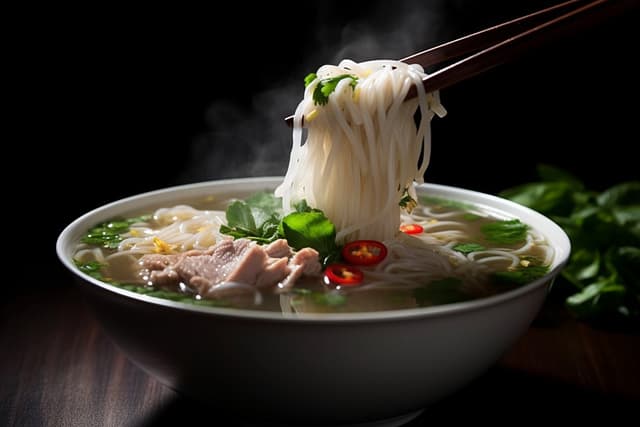
Lan Zhou noodles are not just a dish, but a symbol of Chinese gastronomy, combining craftsmanship, history, and the philosophy of taste. In China, they are called Lanzhou Lamian, or “stretched noodles from Lan Zhou.” They are prepared by hand, stretching the dough into long silky strands, which are then immersed in hot aromatic broth. Today, this dish has conquered the whole world, and even in Canada there are restaurants where masters continue the tradition, preserving the taste and technique that came from ancient Gansu.
Lan Zhou noodles are famous not only for their texture but also for the balance of the five elements without which they would be unthinkable: clear broth, white radish, green onions, red chili oil, and yellow, elastic noodle strands. Each serving is presented as an aesthetic ritual, and a true master can stretch the dough into seven, nine, or even twelve different thicknesses — from the thinnest strands to wide ribbons. This is not a trick, but a demonstration of skill and control over the dough: after all, good noodles require not only the right ingredients, but also a sense of rhythm, precision of movement, and air temperature.
To understand how authentic the noodles in Canadian restaurants are, we went on a gastronomic test—to try Lanzhou noodles in several establishments where they are made by hand. One of the most famous is Nouilles de Lan Zhou in Montreal. Here, it all starts with sound: the short slaps of dough on the table, the long strands flying through the air, and the aroma of beef broth filling the room. The broth here is clear and rich, the meat is tender, and the noodles are perfectly springy. Each bowl reflects a craft that has been perfected to the point of automatism. Visitors note that the taste here is as close as possible to the original Lanzhou, which is rare even in large Asian cities.
In Toronto, GB Hand-pulled Noodles is considered one of the best representatives of the genre, where chefs pull noodles right in front of visitors. The process is turned into a small show, especially for those who are seeing it for the first time. The dough literally comes to life in the hands of the master: it is stretched, twisted, and divided without a knife. The menu offers several options, from classic beef soup to spicy ones with homemade chili and peanuts. The main advantage of this place is the authenticity of the taste. Here, they do not try to adapt the dish to Western tastes, but preserve its authenticity, including rich broth, slightly salty noodles, and a spicy but balanced aroma of spices.
In Vancouver, Peaceful Restaurant, known for its gastronomic reviews and TV shows, is considered a worthy place for tasting. Their noodles have a slightly denser texture, and the broth is cooked on bones for 12 hours. The menu even includes a version with dry noodles and spicy sauce, served with pickled vegetables and peanuts. This version is closer to modern Lanzhou interpretations, but still retains the spirit of tradition.
What distinguishes authentic noodles from imitations are the little things. Real dough is prepared without machines, only by hand, with the right water temperature and salt to achieve perfect elasticity. Real broth is always clear, with a light oily film and the aroma of cinnamon, star anise, and beef. A true master never cuts the dough—he stretches it to the desired diameter, controlling every movement.
After tasting, it becomes obvious that although hundreds of restaurants around the world copy Lanzhou noodles, only a few can convey their authentic character. Nouilles de Lan Zhou in Montreal remains the benchmark in Canada — the combination of skill, aroma, and texture here is closest to the original. GB Hand-pulled Noodles in Toronto follows suit, offering a more street-style but no less authentic version. And Peaceful Restaurant in Vancouver demonstrates that tradition can coexist with a modern style of presentation.
Lanzhou noodles are not just food, they are the language through which China speaks to the world. And as long as the masters continue to stretch the dough by hand, transforming flour and water into strings of flavor, the tradition will live on. The test showed that authenticity is not in the decor or the price tag, but in respect for the craft. And if you want to experience what real Lanzhou Lamian is like, just follow the sound of dough being slapped and the aroma of beef broth.